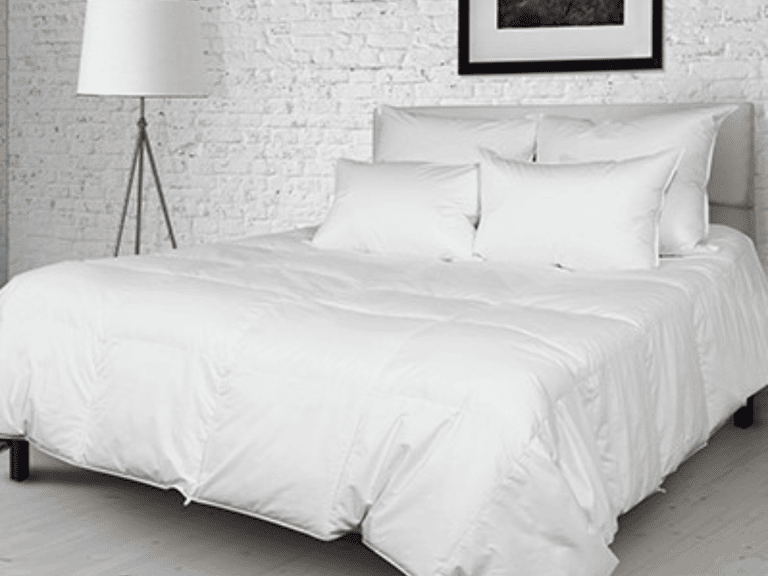
Down insulation, made understandable
Understanding Fill Power in Naturepedic Duvet Inserts
A 750-fill-power label sounds precise, but it is only one clue to how a down duvet will feel. Here’s what the number means, how it relates to warmth, and why fill weight and construction deserve a place in the conversation.
Published November 1, 2026
Shopping for a down duvet can feel like learning a new language. There are fill-power numbers, seasonal weights, shell fabrics, and construction terms, all competing for attention on the same product description. The good news: one of the most prominent figures, fill power, has a straightforward job. It tells you about the loft of the down—how much space a given weight of it can occupy under a standardized test.
Naturepedic’s Organic Down Duvet Insert is described as containing 750-fill-power USA soft white duck down, with a down-proof organic cotton shell and stitch-through box construction. Those details offer a useful starting point. But fill power alone does not reveal the duvet’s total warmth, exact weight, or suitability for every bedroom. To understand the whole picture, it helps to look at how these features work together.
Think of fill power as a measure of efficiency, not a simple warmth score. A higher number can mean that less down is needed to achieve a particular level of loft. Whether an insert feels warm enough—or too warm—also depends on how much down it contains, how it is arranged, the cover fabric, and the sleeping environment.
What does fill power measure?
Down is the soft, three-dimensional cluster found beneath the outer feathers of ducks and geese. Unlike a flat feather, a down cluster has fine filaments that radiate from a central point. Together, those filaments create a springy structure that can hold still air. That trapped air is an important part of down’s insulating ability: it slows the movement of heat between the sleeper and the cooler surroundings.
Fill power measures the volume occupied by a specified weight of down when tested under defined conditions. In common North American labeling, the figure is expressed in cubic inches per ounce. A 750-fill-power down therefore occupies about 750 cubic inches per ounce in the relevant test—not 750 ounces, and not a direct measurement of the duvet’s warmth. Testing methods and standards can vary, so the number is most useful when understood as a standardized indicator of loft rather than a complete performance guarantee.
In practical terms, higher fill power indicates that the down clusters expand to a greater volume for their weight. That can make them useful when a maker wants a lofty, insulating product without adding as much fill mass. It does not mean that every item with a higher number will be warmer than every item with a lower one. A duvet with a lower fill-power rating but substantially more fill may deliver more total insulation.
That distinction is easy to miss because the number looks like a score. It isn’t a comfort rating, a quality grade for the entire duvet, or a promise that one insert will feel a certain temperature to every sleeper. It describes one characteristic of the down itself: its ability to loft under the conditions of the test.
What 750 fill power suggests—and what it doesn’t
A 750-fill-power specification points to down with notable loft per ounce. In a duvet insert, that loft can help create an airy, cushioned feel, while allowing the maker to use the insulation efficiently. For someone seeking warmth without an overly dense or heavy layer, that can be an appealing combination.
Still, “750 fill power” does not answer the questions many sleepers actually have: Will I be warm enough in January? Will I overheat in a centrally heated room? Will the comforter feel light on my body? For those answers, you need more context. In particular, look for the fill weight—the actual amount of down used—and the product’s stated warmth option, such as lightweight or all-season.
The available description for the Naturepedic insert identifies 750-fill-power USA soft white duck down and indicates that lightweight and all-season options are available. It does not provide a fill weight in the information presented here. Without that figure, the fill-power number cannot be used to calculate how much down is inside or to compare total insulation precisely with another model.
That is not a flaw in the number; it is simply a reminder that fill power answers a specific question. When comparing two inserts, check that both their fill-power rating and their fill weight are available. Then consider the construction and intended warmth category. A product description that shares only one of those details leaves part of the story untold.
Fill power and fill weight: two different pieces of the puzzle
It helps to picture fill power and fill weight as describing different things. Fill power is about how much space a certain weight of down can occupy. Fill weight is the quantity of down used in the finished duvet. One concerns loft per unit of down; the other concerns the total amount of insulating material.
Imagine two duvet inserts made with down of the same fill power. If one contains more down, it may have more loft overall and provide more insulation, although the details of its dimensions and construction matter too. Now imagine two inserts with the same fill weight but different fill powers. The higher-fill-power down may create more volume from that amount of material. These comparisons are useful, but neither one turns into a reliable warmth ranking without the rest of the specifications.
Product dimensions matter as well. A larger insert spreads its fill across more surface area, while a smaller one concentrates it over less. If you are comparing queen-size products, make sure both are actually sized similarly; a generously sized insert and a standard-size one may not distribute the same amount of fill in the same way.
In short, a higher fill-power figure can signal efficient loft, while a greater fill weight can contribute to more total insulation. Neither should be mistaken for the entire answer. The best comparison is a complete one: fill power, fill weight, dimensions, construction, warmth category, and the conditions in which you plan to sleep.
Why construction changes the experience
Down needs room to loft, but it also needs to stay distributed. The stitching and internal layout of a duvet help determine where the fill sits and how consistently it covers the bed. Naturepedic describes its Organic Down Duvet Insert as using stitch-through box construction. In this approach, seams join the top and bottom layers at intervals, forming individual sections that help keep fill from migrating too freely.
That arrangement can help maintain a more even distribution of down. But stitching through both fabric layers also creates points where the shell is joined. Those seams may provide a flatter profile and a defined grid; they can also form narrow areas with less loft than the centers of the boxes. How noticeable that is depends on the design, the spacing of the seams, the amount of fill, and how the duvet is used.
Another common construction is baffled-box construction. Internal fabric walls separate the top and bottom shell without compressing them together at every boundary. The walls allow more space for down to expand and can help preserve loft across the chambers. Baffles are not automatically better for everyone: they can create a fuller profile, and the overall warmth still depends on the fill and dimensions. The right construction is the one that suits the intended feel and use.
For the Naturepedic insert, the stated stitch-through box construction is useful information, but it does not tell you the number or size of the boxes. Nor does it establish a precise warmth level by itself. Read it as a design feature that helps organize the fill, not as a substitute for fill weight or the product’s warmth option.
The shell matters, too
A duvet is more than its insulation. Its outer fabric has a close relationship with comfort, durability, and how well the fill stays inside. Naturepedic describes the insert’s cover as down-proof, certified organic cotton. “Down-proof” refers to a tightly constructed fabric intended to help prevent the small down clusters from escaping through the shell.
Cotton is often chosen for bedding because it can feel soft and breathable, although the hand and airflow of a particular shell depend on the fabric’s weave, finish, and weight. A shell that is too loosely woven may allow fill to work through; one that feels crisp or smooth may appeal differently from a brushed or silky fabric. Thread count alone does not settle which shell will feel best, so fabric details are best considered alongside touch preferences and care requirements.
The Naturepedic information identifies its cotton shell as certified organic and states that the insert’s cotton shell has GOTS and Fair Trade certifications. Certifications apply to defined aspects of a product or its supply chain; they should be read according to their stated scope. A certification related to the cotton shell, for instance, should not automatically be taken as a certification of every material or manufacturing step involved in the complete duvet.
It is also worth separating material preference from temperature expectations. A breathable shell can be part of a comfortable bedding system, but it cannot make a high-fill insert inherently cool in every room. Heat retention is influenced by the quantity and loft of the insulation, the sleeper, the room, sleepwear, and other bedding layers.
Choosing lightweight or all-season
Naturepedic lists its Organic Down Duvet Insert in lightweight and all-season options. These labels help narrow the search, but they are not universal technical standards shared by every bedding maker. One brand’s “lightweight” may not feel identical to another’s, because the amount of fill, dimensions, construction, and shell can differ.
A lightweight option may make sense for a warmer bedroom, a hot sleeper, or someone who prefers a thinner covering. It can also work as part of a flexible layering setup: use the lighter insert during mild weather, then add a blanket when temperatures dip. That approach lets sleepers adjust warmth without relying on a single, heavy layer throughout the year.
An all-season option may suit people who want one insert for a wider range of conditions, especially when indoor temperatures remain fairly stable. Even then, “all-season” should not be interpreted as universally comfortable in every climate. A naturally warm sleeper in a heated apartment may prefer less insulation than someone in a cooler home, even if both choose the same labeled category.
Before deciding, consider your usual bedroom temperature, whether you tend to feel warm or cool at night, what other layers you use, and whether your household changes the heating seasonally. If you share a bed, different warmth preferences may call for separate blankets or a layered arrangement rather than one compromise comforter. The label gives you a starting point; your sleep habits complete the decision.
A practical checklist for comparing duvet inserts
When the specifications begin to blur together, use a short checklist. It keeps the focus on the factors that help explain how an insert is likely to perform, without treating any single figure as a verdict.
- Read the fill-power rating. It describes down loft relative to weight, not the duvet’s total warmth.
- Look for fill weight. This is the actual amount of fill in the insert and is essential for a fuller comparison.
- Check the warmth category. Terms such as lightweight and all-season are useful guides, but not identical standards across brands.
- Review the construction. Stitch-through and baffled-box designs organize fill in different ways and can influence profile and distribution.
- Compare dimensions. A difference in size changes how fill is spread over the bed.
- Consider the shell. Fabric type and weave affect feel and are part of the insert’s overall design.
- Check care guidance. Washing and drying requirements can be important for long-term upkeep.
For a Naturepedic insert described as 750 fill power, the useful takeaway is that the down is specified for substantial loft per ounce. The organic cotton shell and stitch-through box design add further context about materials and construction. To make a direct warmth comparison with another duvet, however, you would also want the fill weight, comparable dimensions, and the relevant warmth option.
Care can help preserve loft
Down’s airy structure is part of what makes it appealing, so routine care matters. A duvet cover can help shield an insert from everyday soil and reduce how often the insert itself needs washing. Regularly airing and gently fluffing a duvet may also help it recover its loft after use, though care should always follow the maker’s instructions.
The Naturepedic description recommends spot cleaning and says machine washing may be appropriate in emergencies with specific care guidelines. That caution is worth taking seriously. Down products can be bulky, and washing them incorrectly—or failing to dry them thoroughly—can leave fill clumped or damp. If the care label permits machine washing, use the specified settings and ensure the insert is completely dry before storing or covering it. When in doubt, consult the manufacturer rather than improvising.
Storage is another small but meaningful detail. A down insert should not be compressed for extended periods if the goal is to help maintain its loft. Follow the product’s storage guidance, and avoid putting it away while damp. These habits will not change the fill-power rating, but they can help the duvet retain the loft and feel its design is meant to provide.
Common fill-power misconceptions
“Higher fill power always means warmer.” Not necessarily. It indicates more volume per weight in the tested down. Total fill, size, construction, and use conditions also matter.
“750 fill power means there are 750 ounces of down.” No. The number refers to volume per unit of weight under a testing method; it is not the insert’s fill weight.
“The rating tells me exactly how a duvet will feel.” It cannot account for individual sensitivity to heat, room temperature, the shell’s feel, or other layers on the bed.
“Construction is a minor detail.” Construction influences how the down is held in place and how the insert is arranged. It is one of several factors that shape the finished product.
“A product with fewer specifications must be inferior.” Not necessarily. A short description may simply omit details. It does mean that a precise comparison is harder until the missing information is available.
The bottom line on 750 fill power
Fill power is a useful way to understand down’s loft and insulating efficiency. In Naturepedic’s Organic Down Duvet Insert, the 750-fill-power specification tells you that the down is intended to provide substantial volume relative to its weight. The stitch-through box construction describes how the fill is arranged, while the down-proof organic cotton shell adds information about the encasing fabric.
What the figure does not tell you is the total amount of down in the insert or exactly how warm it will feel in your bedroom. For that, look at fill weight, dimensions, the chosen lightweight or all-season option, and your own sleep preferences. Those details turn a single impressive-looking number into a more useful buying picture.
Ultimately, the best duvet is not necessarily the one with the highest fill power. It is the one whose insulation, construction, size, shell, and care requirements make sense for the way you sleep. Read the rating as one clear piece of evidence—not the whole story—and choosing a down insert becomes a lot less mysterious.